Open Source LLM Orchestration Frameworks Compared: LangChain vs LlamaIndex vs Flowise

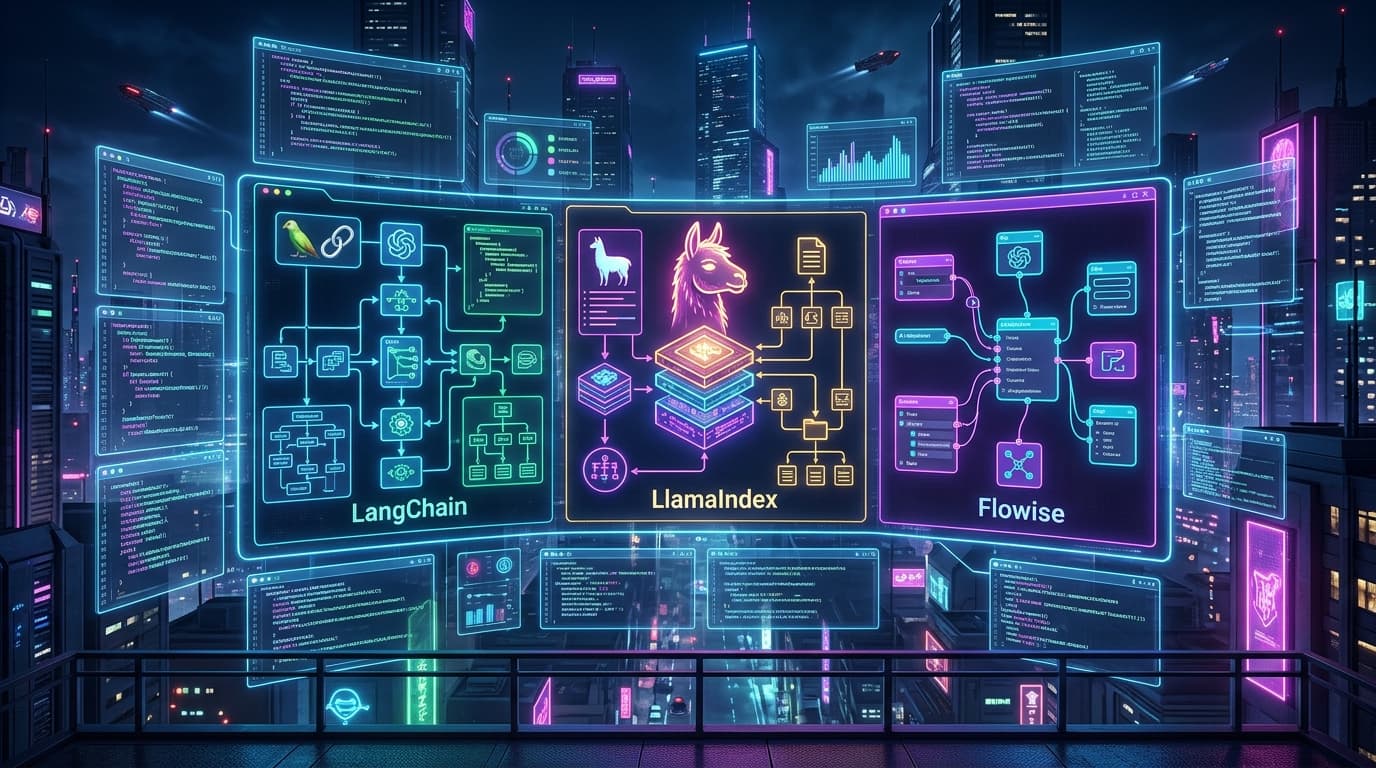
Quick Answer
Open-source LLM orchestration frameworks like LangChain, LlamaIndex, and Flowise simplify the process of connecting language models with data sources and external APIs. This comparison highlights their core strengths, ease of use, and best-fit use cases to help developers choose the right tool.
- LangChain offers maximum flexibility and a massive ecosystem for complex agentic workflows.
- LlamaIndex excels at data ingestion, search, and retrieval-augmented generation (RAG) pipelines.
- Flowise and Langflow provide visual, low-code interfaces ideal for rapid prototyping.
Introduction to Open Source LLM Orchestration Frameworks
Building production-grade Large Language Model (LLM) applications requires much more than simply sending prompt text to an API endpoint. Developers must manage state, chain multiple prompts together, connect models to external data sources via Retrieval-Augmented Generation (RAG), and handle errors gracefully. This complexity birthed a new category of software: LLM orchestration frameworks.
Open-source orchestration frameworks have become the bedrock of modern AI engineering. They abstract away the boilerplate code needed to talk to vector databases, manage conversation memory, and build autonomous agents. However, with dozens of tools available, choosing the right one for your specific architectural needs can be overwhelming.
In this comprehensive guide, we will compare the top open-source LLM orchestration frameworks on the market, analyze their core strengths, and help you select the optimal tool for your next AI initiative.
PromptGrid AI Insight: The best framework is rarely the one with the most GitHub stars; it is the one that aligns with your team's existing tech stack and your application's architectural bottlenecks.
Top Open Source LLM Orchestration Frameworks Compared
The ecosystem is maturing rapidly. Let's examine the standout open-source frameworks dominating developer mindshare today.
1. LangChain: The Swiss Army Knife for Agentic Workflows
LangChain is arguably the most recognized name in LLM orchestration. Designed with a highly modular architecture, LangChain provides standard interfaces for chains, agents, prompts, and memory.
- Core Strengths: Massive integration ecosystem (hundreds of vector stores, LLMs, and APIs), robust agent frameworks (LangGraph), and extensive community support.
- Best Suited For: Complex, multi-step agentic workflows and applications requiring integration with diverse third-party services.
from langchain.chains import LLMChain
from langchain_core.prompts import PromptTemplate
from langchain_openai import OpenAI

llm = OpenAI(temperature=0.9)
prompt = PromptTemplate(
    input_variables=["product"],
    template="What is a good name for a company that makes {product}?",
)

chain = LLMChain(llm=llm, prompt=prompt)
print(chain.run("eco-friendly water bottles"))
2. LlamaIndex (formerly GPT Index): The Master of Data Ingestion and RAG
While LangChain focuses heavily on general chaining and agents, LlamaIndex was built from the ground up to solve one specific, massive problem: connecting custom data to LLMs.
- Core Strengths: Superior data connectors (PDFs, APIs, databases), advanced indexing structures (tree, vector, keyword tables), and state-of-the-art query engines.
- Best Suited For: Knowledge bases, enterprise search, and complex RAG applications where data fidelity and retrieval accuracy are paramount.
from llama_index.core import Document, VectorStoreIndex

# Ingest data easily from custom sources
documents = [Document(text="PromptGrid AI is a leading enterprise prompt management platform.")]
index = VectorStoreIndex.from_documents(documents)

query_engine = index.as_query_engine()
response = query_engine.query("What is PromptGrid AI?")
print(response)
3. Flowise & Langflow: Visual, Low-Code Orchestration
For teams looking to prototype rapidly or enable non-technical stakeholders to build AI workflows, visual orchestration tools like Flowise and Langflow have emerged as game-changers.
- Core Strengths: Drag-and-drop UI, visual debugging, built on top of LangChain, and fast time-to-prototype.
- Best Suited For: Rapid prototyping, internal tooling, and cross-functional teams collaborating on AI apps.
Key Comparison Criteria for LLM Frameworks
When evaluating these open-source frameworks, engineering leaders must evaluate them against several critical dimensions:
Ease of Use and Developer Experience
Some frameworks prioritize granular control over every API call, resulting in a steeper learning curve (e.g., LangChain). Others abstract the complexity behind opinionated patterns or visual canvases (e.g., Flowise), allowing developers to build functional pipelines in minutes.
RAG and Data Pipeline Capabilities
If your application relies heavily on querying private enterprise data, evaluate how easily the framework handles chunking strategies, metadata filtering, and hybrid search. LlamaIndex currently leads this category, though LangChain offers robust RAG toolkits as well.
Agent Support and State Management
Building autonomous agents requires cyclic workflows, error recovery, and robust state persistence. Frameworks like LangChain (via LangGraph) provide advanced primitives for stateful, multi-agent systems.
Use Case Scenarios: Which Framework Should You Choose?
To make your decision easier, let's map frameworks to real-world deployment scenarios:
- Enterprise Knowledge Retrieval (RAG): Choose LlamaIndex. Its indexing mechanisms and data connectors make it unmatched for searching unstructured corporate documents.
- Autonomous Multi-Agent Systems: Choose LangChain / LangGraph. Handling loops, conditional routing, and persistent agent state is native to its ecosystem.
- Rapid MVP Development & Demos: Choose Flowise or Langflow. Dragging and dropping nodes allows you to validate a concept with stakeholders before writing production backend code.
Pro Tip: Many enterprise teams adopt a hybrid approach—using LlamaIndex for the data retrieval backend and LangChain for the overarching agent logic.
Conclusion and Future of LLM Orchestration
The open-source LLM orchestration landscape is shifting rapidly from simple linear chains to robust, stateful agent architectures. As models become more intelligent and context windows expand, the role of orchestration frameworks will evolve from mere glue code to sophisticated control planes for autonomous enterprise AI systems. Evaluate your team's core competencies, start with a focused proof-of-concept, and choose the framework that scales best with your long-term product roadmap.
Copy Prompt Box
Last verified on Nov 5, 2026 by the PromptGrid AI Editorial Team.